Budapest Gellért Baths
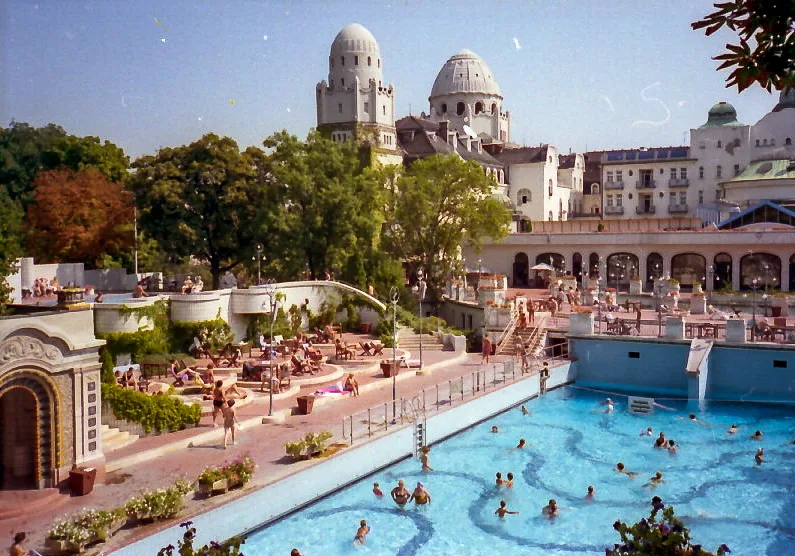
- Location
- Budapest XI, Hungary
- Water type
- sodium chloride
- Temperature
- 44 °C
- pH
- 7.2
Water profile
Relaxing — deep, immediate muscle release.
Loaded with major ions — the essential minerals (Ca, Mg).
Dense, salty water — you float without effort.
On the slopes of Budapest's Gellért Hill, warm waters have flowed for centuries: as early as the 13th century King Andrew II built a small hospital here, before Ottoman-era baths took over the site after the 1526 conquest. But the bathhouse we know today was built between 1912 and 1918, an Art Nouveau masterpiece by Hungarian architects Artúr Sebestyén and Izidor Sterk, later expanded in 1927 with a wave pool and in 1934 with a glass-domed thermal hall.
Mosaics, stained glass and wrought ironwork adorn the grand hall beneath its glass roof, a distinctly Hungarian take on the Secession style. Bombed in 1945 and restored to its former splendor in 2008, Gellért remains one of Europe's finest showcases of bathing tradition, fed by water rich in calcium, magnesium and sulfates.