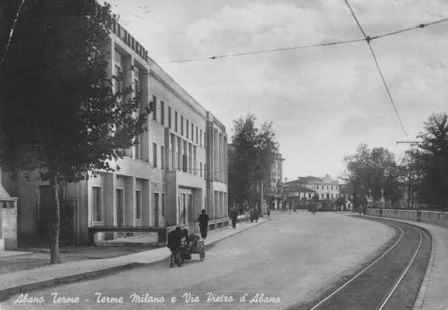
Terme di Abano — Pietro d'Abano
- Location
- Abano Terme, Italy
- Water type
- radioactive, sodium chloride
- Temperature
- 87 °C
- pH
- 7.2
Water profile
Relaxing — deep, immediate muscle release.
Rich in active gases or metals — a strong mineral character.
Dense, salty water — you float without effort.
Terme di Abano draws radoniferous and chlorurated thermal waters from the volcanic formations of the Euganean Hills in the Veneto plain south of Padua, where hyperthermal springs at 86 to 87 degrees Celsius feed the fangotherapy pools, the most medically sophisticated system of thermal mud treatment in Europe, in which volcanic clay is matured in thermal water for sixty to ninety days before application and then replenished across twelve-month cycles. Padua, fifteen kilometres north across the flat Venetian plain, houses the Scrovegni Chapel decorated between 1303 and 1305 by Giotto di Bondone in the first great cycle of naturalistic fresco painting in Western art, whose revolutionary use of foreshortening, emotional individualism, and spatial depth invented the pictorial conventions that made the Italian Renaissance possible. Pietro d'Abano, the thirteenth-century philosopher and physician after whom the thermal town is partly named, was one of the first European scholars to attempt a synthesis of Arabic medicine, Aristotelian natural philosophy, and the practical observation of hot spring water, making the Euganean Hills a place where thermal science and intellectual history have been intertwined for seven centuries.