Baños del Inca
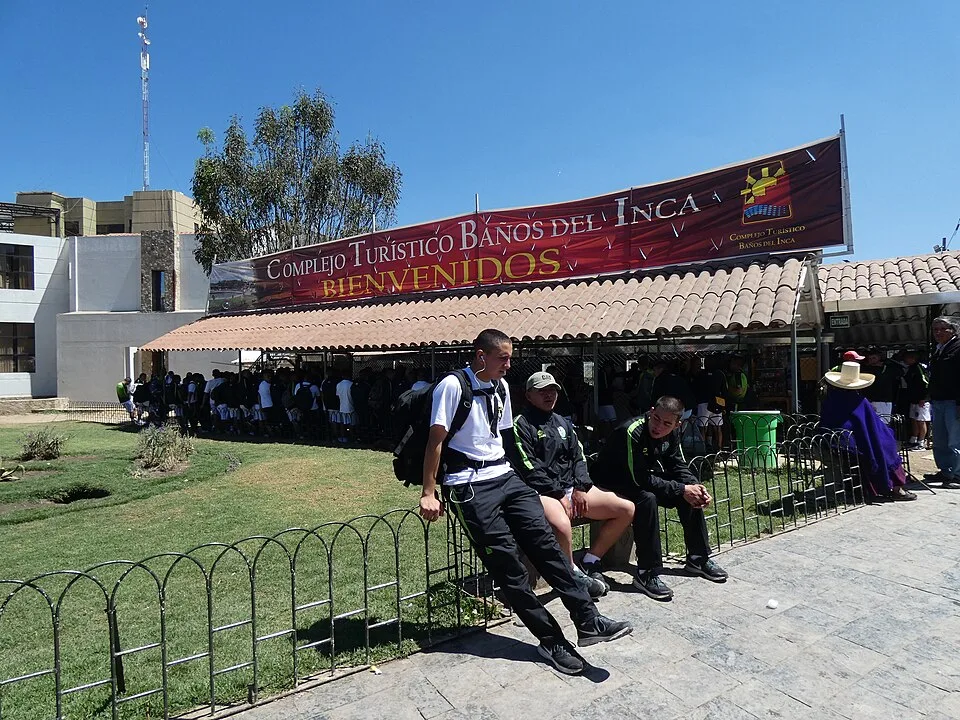
- Location
- Cajamarca, Peru
- Water type
- bicarbonate
- Temperature
- 72 °C
- pH
- 8
Water profile
Relaxing — deep, immediate muscle release.
Loaded with major ions — the essential minerals (Ca, Mg).
Soft water — natural, classic buoyancy.
Banos del Inca draws bicarbonated thermal springs in the valley of Cajamarca in the northern Peruvian highlands, where hot springs at up to 75 degrees Celsius have been used since before the Inca period and were, according to Spanish colonial chronicles, the personal bathing springs of the Sapa Inca Atahualpa, who was at Cajamarca taking the therapeutic waters when Francisco Pizarro's conquistadores arrived in November 1532 and captured him in the ambush that ended the Inca Empire in a single afternoon. The stone-lined bathing pool attributed to Atahualpa, still visible within the complex and maintained as a monument of Andean pre-Columbian heritage, was reportedly heated so hot that the Inca's servants poured cold water to cool it to a comfortable temperature, a detail recorded by Spanish witnesses that gives the geothermal springs of Cajamarca their precise historical context within the most consequential encounter between European and American civilisations. The bicarbonated hot springs of Banos del Inca, now one of the most visited thermal sites in Peru, flow in a valley where the memory of Atahualpa's capture, the ransom of gold and silver that failed to save him, and the subsequent conquest of twelve million people's civilisation gives every warm mineral pool a historical weight that the therapeutic properties of the water alone could never carry.